Researcher Spotlight: Rethinking How We Measure the Value of Obesity Treatments in the GLP-1 Era
November 2, 2026Neeti Kulkarni, a PhD student at the University of Michigan, aims to measure how people value different obesity-related health outcomes and treatments, including GLP-1 medications.
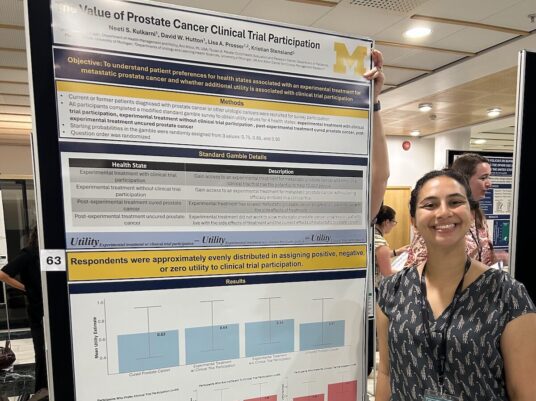
Neeti Kulkarni has always been interested in finding ways to improve the world around her, and that’s one of the reasons she was drawn to economics. “To me, that’s the foundation of economics — improving things by making them more efficient,” she said.
When Kulkarni took a college class on the U.S. health care system, she saw the potential of health economics to improve a flawed system. “It was a light bulb moment where I thought, ‘This space really needs help,’” she said.
Now a PhD student at the University of Michigan, Kulkarni received a 2026 PhRMA Foundation Predoctoral Fellowship in Value Assessment and Health Outcomes Research for her project measuring how people value different obesity-related health outcomes and treatments, including GLP-1 medications.
“The introduction of GLP-1s in the last few years has completely upended the treatment space and how patients feel about different treatment alternatives,” she said. While use of GLP-1s has rapidly increased, little is known about how people view these medications compared with alternative treatments such as bariatric surgery.
When assessing the value of treatments, researchers often use measures called “utility estimates” to capture the value that people place on different health outcomes and their effects on quality of life. However, the estimates currently used in obesity research do not capture the full patient experience, Kulkarni said.
“We’re in a pivotal time in this space where we’re starting to consider not just the physical dimensions of health for obesity but also the mental health impacts like social stigma and emotional well-being,” she said. “That’s a huge part of the obesity experience that we really haven’t considered before.”
With guidance from a patient advisory group, Kulkarni is developing a survey about obesity-related health and treatment experiences. She will use the responses to create updated utility estimates that better reflect how people weigh the benefits, risks, and experiences associated with different obesity interventions. “We can plug the new utility values into a cost-effectiveness model to better assess the benefits of different treatments and, ultimately, help guide policy decisions,” she said.
Kulkarni particularly enjoys the collaborative aspects of research and finding ways to make the work fun. Last year, she and her colleagues got into a debate about which disciplines in her field (political science, sociology, decision science, economics, etc.) matched best with local ice cream shops in Ann Arbor. They conducted a student survey and even put together an abstract and presentation.
“Our conclusion of the study was that the department should buy us more ice cream so we can further our findings,” she said. “We put the abstract on a professor’s door in the department. He has all these really big papers from his field and then sandwiched in between those is our little ice cream abstract, which is called ‘Cognate Creamery Concordance: A Matching Experiment.’”
Kulkarni joked that it was pretty high-quality research and writing. “I feel like that is very characteristic of who I am as a researcher,” she said. “I will always do good-quality work, but I will also always have fun while doing it.”
 Kulkarni’s creative, fun-loving side extends beyond her research. She majored in music as well as economics in college and currently plays the viola in several local groups, including a Life Sciences Orchestra whose members include doctors, nurses, and others working in the health care space.
“It’s a very rewarding hobby to have and a really humbling experience too,” she said. “You have some big names in research who are playing an instrument. You see them in a very different context than what you’re used to, and it makes the research community feel a little smaller and more comfortable.”
In the future, Kulkarni hopes to become a university professor who engages in a combination of teaching and research. The PhRMA Foundation award has helped strengthen her confidence in pursuing this career path.
“Since I’ve started my PhD, we’ve seen public health funding go completely down and things have been feeling very bleak,” she said. “It was really scary to think about getting grants and how I was going to do this in the future. Getting the Foundation award gave me so much validation and confidence that this is a career I could pursue, and that was so needed for me to be able to move forward in this space.”