Researcher Spotlight: Measuring the Hidden Impact of Stigma in Sickle Cell Disease
July 27, 2026As a PhD student at The University of Texas at Austin, Ayobami Aiyeolemi is developing a first-of-its-kind tool to measure sickle cell disease stigma and improve patient care.
While working as a pharmacist in Nigeria, Ayobami Aiyeolemi observed that patients taking the same medication could have very different health outcomes depending on social factors that also influenced their health care.
“I began to appreciate how different factors like transportation needs and social support could really change health outcomes for patients,” he said. “Patients have non-medical challenges that we need to address so that their medications work for them.”
Aiyeolemi’s interest in these social determinants of health led him to pursue his PhD in health outcomes research at the University of Texas at Austin. Among the many social factors that influence health, stigma remains one of the most difficult to measure and one of the most damaging for people living with sickle cell disease.
Aiyeolemi received a 2026 PhRMA Foundation Predoctoral Fellowship in Value Assessment and Health Outcomes Research for his work focused on understanding and measuring stigma in sickle cell disease (SCD), a group of inherited blood disorders in which misshapen red blood cells clog blood vessels, causing severe pain, organ damage, and anemia.
Stigma is a major barrier to care for individuals with SCD. People with SCD may encounter racial bias and misconceptions about pain management. More than 90% of Americans with SCD are Black. People with SCD often experience chronic pain and frequent, acute pain crises requiring medication, leading health care providers to mislabel them as drug seekers.
Without reliable ways to measure stigma, it is difficult for researchers and health care systems to understand its impact on patients or evaluate whether efforts to reduce stigma are working. Aiyeolemi will interview individuals with SCD to inform his research to develop and validate a comprehensive SCD stigma scale.
“Something that really excites me about the work is that I’m using an approach called community-based participatory research,” he said. “I’m not just involving patients as participants in my studies. They’re partners in the research process.”
This approach helps ensure that the questions being asked and the tools being developed reflect the real experiences and priorities of the people most affected by the disease. Aiyeolemi hopes his stigma scale will help researchers, clinicians, and health systems better understand how stigma affects SCD patients’ health, quality of life, and access to care. Ultimately, it could help guide interventions designed to reduce stigma and improve outcomes.
“My country, Nigeria, has the highest burden of sickle cell disease in the world, so although I’m working here in the U.S., I’m hoping that someday my work can translate to those people in Nigeria and also people living with sickle cell disease all over the world,” he said.
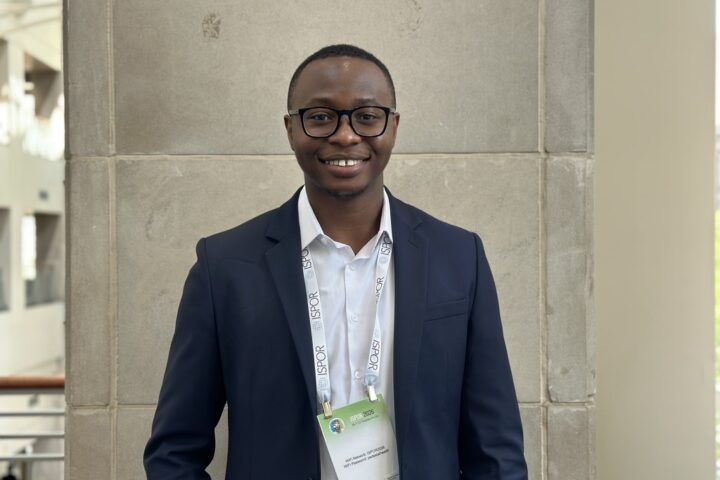
As an international student studying in the United States, Aiyeolemi said there are limited opportunities for him to secure support for his research. “This award is a really big deal for me to be able to have protected time to do my research,” he said. “I’ve had the fellowship for a few months, and I can already see the difference in the way I approach my work. I’m able to spend more time on my research and ultimately produce better work.”
He reflected that earlier in his career journey he had been very risk averse and wary of pursuing opportunities like the PhRMA Foundation award. “I felt I needed to be overly prepared and have everything in order to seek out opportunities,” he said. “But life doesn’t work out that way. People who do big things don’t have everything figured out. They just take calculated risks.”
Aiyeolemi wants to do research that could have a large impact on people’s lives. He hopes to eventually become a tenured professor and build a research program that centers on conditions that impact marginalized populations and the impact of social determinants of health like stigma. “I’d like to become an authority in that area of research,” he said.