Researcher Spotlight: Exploring the Real-World Effects of GLP-1 Medicines in Children and Adolescents
October 13, 2026Pareeta Kotecha, a PhD student at the University of Florida, will assess adherence to GLP-1 medicines as well as the risk of depression, anxiety, and thoughts or acts of suicide among children and adolescents.
Pareeta Kotecha was always reminding her grandmother to take her diabetes medicine, so she knows how hard it can be for patients to stick to their prescriptions. “I saw that firsthand in my own house,” she said.
Clinical trials are the gold standard for testing new medicines to ensure they are safe and effective. But after seeing her grandmother struggle with treatment, Kotecha became curious about what happens after medicines reach patients in the real world, where access to treatment, healthcare systems, and individual patient experiences can vary considerably.
“I’ve always been someone who questions a lot of things, and that’s what led me to research,” she said. “Does that work in the real world? I don’t know, so I want to find out for myself.”
Now a PhD student at the University of Florida, Kotecha received a 2026 PhRMA Foundation Predoctoral Fellowship in Value Assessment and Health Outcomes Research for her work exploring the real-world impacts of GLP-1 medicines in children and adolescents with obesity and type 2 diabetes.
Obesity affects about one in five children and teenagers in the United States and raises their risk of type 2 diabetes. Although GLP-1s are increasingly used to treat these conditions, little is known about medication adherence and mental health effects in pediatric patients. GLP-1s were first approved for adolescents with type 2 diabetes in 2019 and obesity in 2020.
“I want to look at how safe they are, especially with the concerns that have been coming out about the potential psychological impacts that these medications could have,” Kotecha said.
Using health records and insurance claims from 2019-2025, she will assess adherence to GLP-1 medicines as well as the risk of depression, anxiety, and thoughts or acts of suicide among children and adolescents taking GLP-1s and those taking metformin, another medicine used in these conditions.
Kotecha will also conduct interviews with patients, parents, and doctors to learn what makes it easier or harder for adolescents to start and continue GLP-1 treatment. She wants to learn what challenges doctors face when prescribing the medicines, what helps the children and adolescents stay on them, and what might lead some patients to stop taking them or not even start them in the first place.
“Hopefully this work inspires other people to take that step in the future of talking to patients more, rather than just relying on the data alone,” she said. Kotecha hopes the findings will help families and doctors make informed choices about the safe and effective use of these medicines.
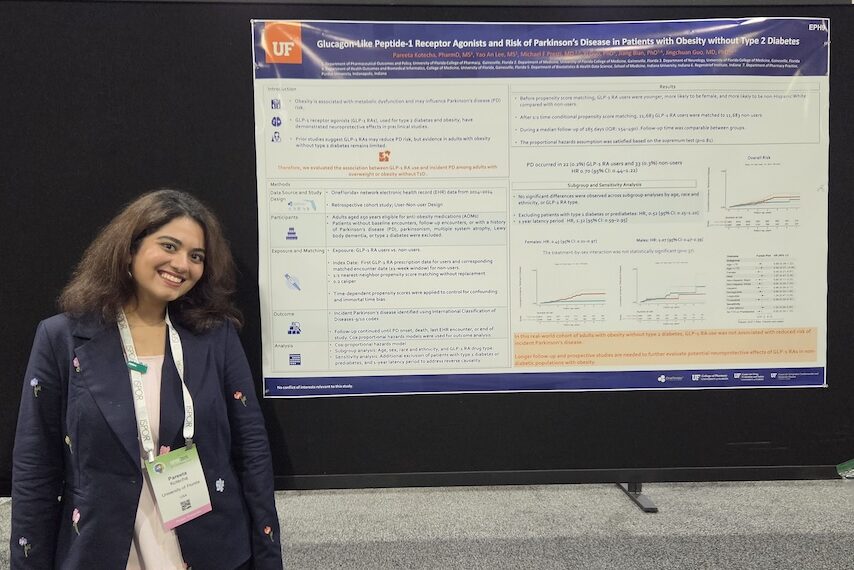
For Kotecha, the most enjoyable part of research is being able to ask and answer her own questions. “If I think of something, I have the freedom to explore that — and not everyone has access to the tools to do that,” she said. While pursuing her pharmacy degree in India, Kotecha did not have the kinds of resources she has today. Coming to United States and specifically University of Florida helped drive her curiosity and expand her opportunities.
“I’m grateful to PhRMA Foundation because I get to spend more time on my research,” she said. “Having support early on in my career really strengthens my passion for research. Research is a long journey and sometimes you lose hope and motivation along the way, so having someone who believes in your research pushes me to keep going.”
Outside the lab, Kotecha recharges and channels her curiosity through creative pursuits such as art and baking. “I really like doing anything that’s artsy or fuels my creativity in some way,” she said. “Recently I’ve been into baking focaccia bread and also trying to hand build some pottery, like functional vessels.”
As she pursues a research career, Kotecha has learned to be less afraid of taking risks or pushing back when she disagrees with someone. “When someone challenges you, don’t be afraid,” she said. “Take the risk anyway and see what happens. If it works out, it’s great, and if it doesn’t, it’s a great learning opportunity for you to improve next time.”
For her future career goals, Kotecha wants to continue conducting health outcomes research that is meaningful and patient centered. She previously interned at two pharmaceutical companies, where she had a chance explore topics such as patient-centered drug development and value assessment.
“I want to take the learnings from my experiences and try to give back to patients,” Kotecha said.