Q&A with Meredith Nix: Harnessing Cancer’s Vulnerabilities to Develop New Therapies
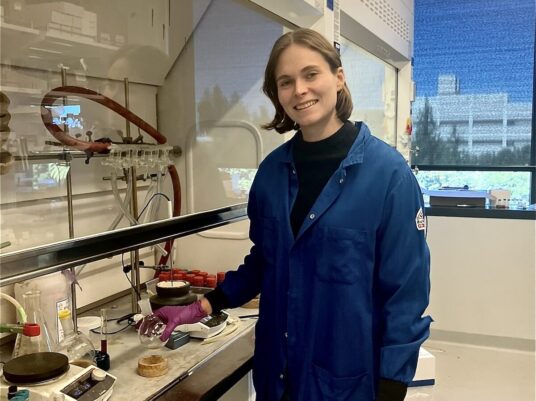
November 9, 2026Meredith Nix, a PhD student at Stanford University, received a 2026 PhRMA Foundation Predoctoral Fellowship in Drug Discovery.
Provide a summary of your PhRMA Foundation-funded research.
About 4% of non-small cell lung cancers are driven by an abnormal fusion protein called EML4-ALK, which forms when two genes become joined together. While drugs targeting the ALK protein can help patients initially, most tumors eventually develop resistance, underscoring the need for alternative treatment strategies. EML4-ALK fusion proteins form distinct droplets within cancer cells. Instead of destroying these droplets to halt cancer signaling, we aim to harness them to selectively cluster and activate proteins that cause cancer cell death. Because only cancer cells contain EML4-ALK droplets, this approach should cause cancer cells to die while sparing healthy cells. If successful, this research will introduce a new drug discovery strategy that co-opts this unique feature of cancer cells to selectively kill them.
Why did you become a researcher?
When I was a kid, my dad was diagnosed with type II diabetes. That was really my first exposure to disease and to seeing how much a medical diagnosis could affect someone’s everyday life. I became interested in understanding the underlying biology of disease and how that knowledge could inform treatment or management. Then, in middle school, I started to see science as a real career possibility when I participated in an after-school program called Techbridge, which exposed young women in Oakland public schools to engineering. I really loved the problem-solving aspect of engineering, and over time this initial interest evolved into a fascination with molecular biology and organic chemistry. Naturally, these two fields led me to chemical biology and drug discovery.
I ultimately chose to focus my research on cancer because of the devastating toll it takes on patients and their families. My work at the NIH after college and now at Stanford has focused on exploiting vulnerabilities in cancer to selectively kill malignant cells. It’s not that hard to kill a cell — but to kill cancer cells without harming healthy ones is the key to developing effective therapies. That challenge is at the center of my PhRMA Foundation project.
Tell us an interesting story from your career journey.
One of my favorite stories from my PhD is when I was trying to learn X-ray crystallography for one of my projects. I had developed a compound that kills lymphoma cells by inducing proximity between two proteins that leads to the transcription of cell death genes. My mentor suggested that I try to solve the X-ray structure of the complex, comprised of the two proteins and the compound (which we call a ternary complex), even though the likelihood of success was very low.
I had never purified proteins or done much biochemistry, so I started learning that summer. Eventually, I was able to isolate the ternary complex, but at a concentration much lower than what is typically used for crystallography. Thinking I would never use the sample, I left it in the fridge for a week, which is a big no-no in crystallography, where fresh samples are ideal. I tried preparing a better sample but wasn’t successful. Eventually I decided to just go ahead and attempt crystallography with the original sample. To the shock of my mentor and I, we saw hundreds of crystals form immediately. We collected X-ray data on 40 crystals and got four clean datasets back, one of which was very high quality and is now published. It was a classic example of beginner’s luck, and safe to say, I haven’t been able to generate X-ray data for a ternary complex since! This incidence really showed me the role serendipity can play in science.
What is a common misconception people have about science?
A common misconception is that science is a solitary and isolated career path. Many people picture scientists working alone in some basement running experiments. In reality, scientific discovery is incredibly collaborative. Different people bring unique expertise to a project, and often you need all of these perspectives to tackle challenging questions. I’ve found that some of the most impactful discoveries emerge from collaborations spanning institutions, countries, and continents. Getting to work with so many amazing scientists in other fields has been one of the most rewarding parts of being a researcher.
What do you love most about research?
I love the field of drug discovery because of the creativity it requires. Every project presents a different set of challenges and requires you to learn new things, approach problems from different angles, and collaborate with people who have expertise you don’t. Often, answering one question leads to 10 new ones, which is part of what makes research so exciting to me. My own projects have pushed me into areas ranging from chemistry and biochemistry to cancer biology and structural biology, so I feel like I’m constantly learning. And ultimately, it’s incredibly rewarding to know that the discoveries we make could one day contribute to better treatments for patients. That possibility is a huge motivation for me.
What do you like to do outside of research?
Outside of research, I really enjoy endurance sports, especially running and cycling. I particularly love trail running and exploring the outdoors this way. I’ve run several marathons, and this past summer I completed a few 100-mile bike rides. More recently, I’ve also gotten into swimming and have been training with the Stanford Triathlon Club.
What advice would you give to your younger self?
I would tell myself that when something isn’t working, take some time to reflect. Early in my PhD, I had the mindset that the more I worked, the more problems I would solve. Over time, I’ve learned that when I’m really stuck, simply spending more time in the lab often isn’t what leads to a solution. Instead, taking a step back, rereading the literature, talking through problems with lab members, or just giving myself a few days to think is often what ultimately leads to a breakthrough.
What are your career goals?
My overarching career objective is to establish an independent lab focused on employing chemistry to develop novel and selective cancer therapeutics. Specifically, I aim to chemically exploit cellular machinery unique to cancer for therapeutic purposes. Ultimately, I hope to develop therapies for cancers that are difficult to treat, while also mentoring and training the next generation of chemical biologists.
Learn more about the PhRMA Foundation’s fellowship and grant opportunities. Check out more researcher stories on our blog.