Q&A with Dr. Dakota Brockway: Eavesdropping on the Brain to Map the Biology of Addiction
May 11, 2026Dr. Dakota Brockway, a postdoctoral trainee at the University of Pittsburgh, received a 2026 PhRMA Foundation Postdoctoral Fellowship in Drug Discovery.
Why did you become a scientist?
I came to science because I wanted to understand how biology turns into behavior, how a few pounds of tissue inside our skulls produce thought, choice, love, and addiction. But what kept me in science was realizing that nature plays by rules. You can ask it a precise question and, if you ask carefully enough, it answers.
My first real taste of that came as an undergraduate, working on natural products as potential therapies for glioblastoma, one of the most aggressive brain cancers. We were screening compounds, hoping for a hit. When I identified a molecule that genuinely slowed glioblastoma cell growth, something clicked. It wasn’t just a result on a screen, it was the dawning realization that a single careful experiment could, one day, reach a patient. That moment pulled me into the mindset of drug discovery, and it has never let go.
My mentors shaped the rest. They taught me that good science isn’t about proving yourself right; it’s about being honest with the data, even when it tells you something inconvenient. Curiosity, logic, and integrity, those three together became the reason I wanted to build a career in science.
Provide a brief summary of your PhRMA Foundation-funded research.
My research zooms in on a small molecule with an outsized influence: vasoactive intestinal peptide, or VIP. In the prefrontal cortex, the part of the brain that weighs options and ultimately drives our decisions, VIP shapes the conversations between neurons that guide behavior. My job, in a sense, is to listen in on those conversations.
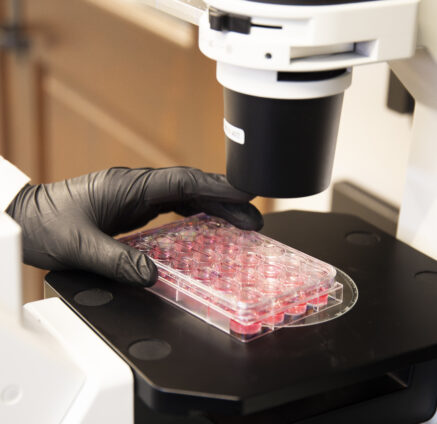
To do that, I keep thin slices of brain tissue alive in a dish and guide a glass electrode, finer than a strand of hair, onto a single neuron. The electrode gives me access to the inside of the cell, so I can hear that one cell’s electrical voice in real time. What we’ve found is striking: VIP doesn’t just nudge these brain circuits, it reshapes them. By hijacking this pathway, alcohol can push the brain toward harmful patterns of use.
My goal is to map exactly how this happens and then use that map to design treatments that fix the specific problem. For people struggling with alcohol use disorder, that could mean medications that correct the underlying biology without the heavy side effects of broader-acting drugs.
What was a memorable moment from your career journey so far?
I’ll never forget the first time I successfully patched a neuron. You spend long, quiet minutes nudging a microscopic glass pipette through tissue, watching the screen for the tiny dimple that tells you you’ve found a cell. When you apply the smallest whisper of suction, the seal forms, and suddenly, on the monitor, the cell’s electrical signature is right there, alive and chattering. You’re eavesdropping on a conversation between neurons in the brain.
Now, one of my favorite parts of the job is teaching students to do the same thing. I’ve watched students go from white-knuckled at the rig to recording in a single afternoon. That moment of recognition on their faces — “I’m listening to a brain right now” — never gets old. The bonus is that they often catch patterns I missed or ask questions I hadn’t thought of. Science works best when ideas get challenged from a fresh angle.
What is a common misconception people have about science?
People tend to imagine science as a series of “eureka!” moments, a lone genius shouting in an empty lab. The reality is much more humbling. Most progress comes from testing ideas, being wrong, refining the approach, and being wrong a little less.
In my own work, the smallest details, like how a slice of tissue is cut, the temperature of a liquid, or the angle of an electrode, can completely change what the data look like. The discipline isn’t about being right the first time. It’s about being rigorous enough to recognize when you’re wrong and humble enough to change course.
What do you love most about research?
Research lives at the intersection of logic and creativity, and that’s the part I love. You’re bound by rules, such as reproducibility, statistics, and controls, but the most interesting moves come from thinking sideways, from asking a question nobody else has thought to ask.
A lot of my work has involved building new ways to measure signaling in living brain tissue, creating methods that didn’t exist before, so we can ask questions that weren’t previously askable. That’s where research starts to feel like an art form. You frame the right question, you set up the experiment carefully, and if you’ve done it well, nature gives you an honest answer. There is almost nothing else like it.
What do you like to do outside of research?
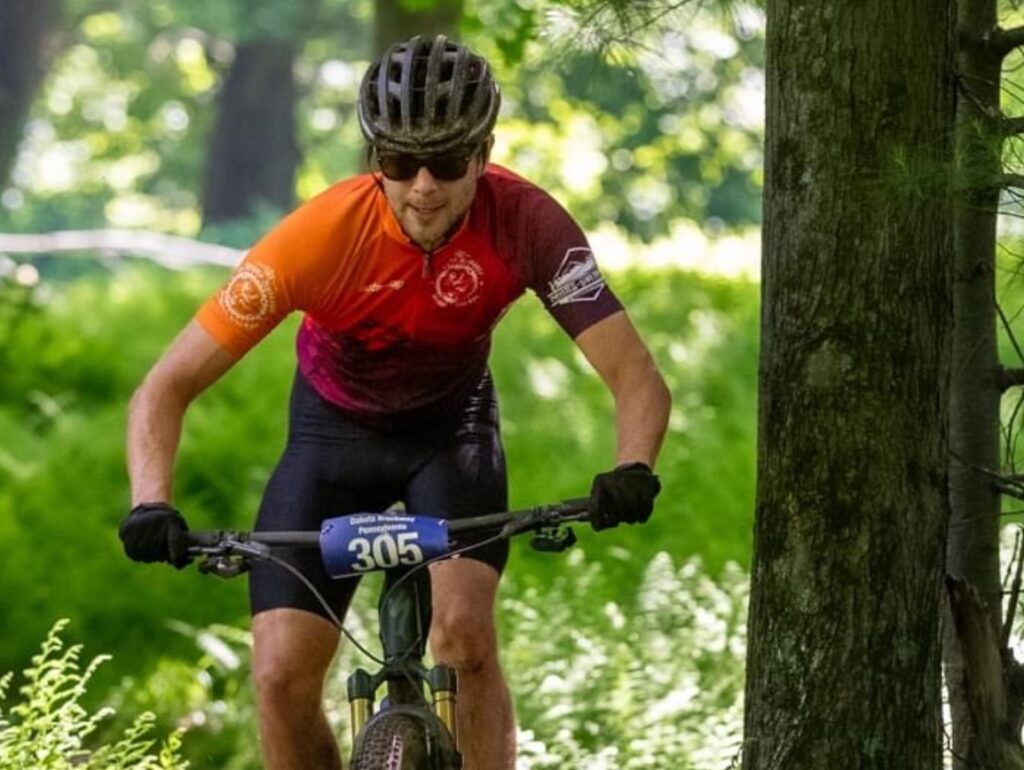
When I’m not at the rig, I’m usually outside. I love mountain biking and hiking, and some of my favorite memories live on the Appalachian Trail. I gravitate toward activities that demand focus. There’s always a moment on a technical descent where you must fully commit to the line in front of you and you become lost in the activity.
My free time is spent with my girlfriend and our golden retriever, who is gloriously unconcerned with my experimental controls and my unpublished p-values. This is exactly the kind of perspective I need at the end of a long day.
What advice would you give your younger self?
I would advise my younger self to ask the questions you actually care about — even the ones that don’t fit the standard path. The most interesting ideas usually come from someone willing to step a few feet off the established trail. Most importantly, lean on your mentors early. The conversations I had as a student about how to think, how to approach a problem, how to keep your integrity intact when results don’t go your way, shaped me more than any single experiment ever did.
What are your future career goals?
My goal is to run my own lab as a professor, leading a research program that turns basic neuroscience into biologically grounded treatments for brain disorders. I want to take ideas from the bench and push them, step by step, toward real clinical impact.
A big part of why this matters to me is the people. Addiction is one of the hardest illnesses to overcome, not because patients aren’t trying, but because the disease quietly rewires the very brain circuits that we use to make decisions. I want to help build the next generation of treatments for those individuals.
This award is a real step in that direction. It supports my training in drug discovery while letting me pursue the kind of mechanism-driven neuroscience I hope will, eventually, reach the people who need it most.
Equally important to me: I want to train students the way my mentors trained me. Encourage them to think independently, challenge assumptions, and pursue creative ideas that move the field forward. Discoveries are great. Building scientists who go on to make their own discoveries is better.