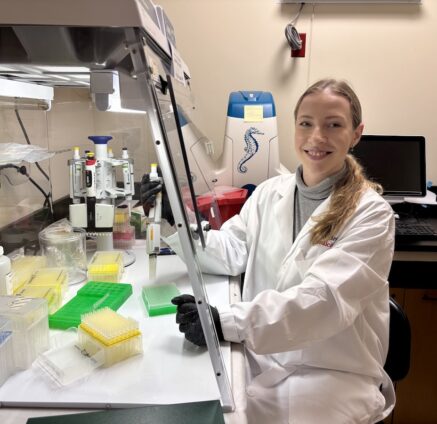
Q&A with Anastasiia Vasylaki: Developing Nanomedicines to Deliver Gene Therapy for Kidney Diseases
June 4, 2026Anastasiia Vasylaki, a PhD student at City College of New York, received a 2026 PhRMA Foundation Predoctoral Fellowship in Drug Delivery.
Provide a brief summary of your PhRMA Foundation-funded research.
How does a drug know where the disease is located and where the treatment is needed? The short answer is: It doesn’t. The drug goes everywhere in the body and affects even healthy cells, which makes it less effective and can lead to side effects. My research tries to address this issue in the treatment of kidney diseases. Our lab developed a nanoparticle that accumulates specifically in the kidneys. We found that these nanoparticles concentrate in the kidneys over 20 times more than in other organs. With this selective system, we want to develop a new treatment for chronic kidney disease, which affects 1 in 7 American adults. The disease is also closely tied to high blood pressure — each condition can worsen the other, creating a damaging cycle. We will use our nanoparticles to deliver a gene therapy that silences a key protein called NF-κB, which drives inflammation and injury in the kidneys. We are hoping that this treatment will slow or stop the progression of chronic kidney disease associated with high blood pressure.
Why did you become a scientist?
I was fascinated with biology since high school. I was eager to figure out the logic behind how living systems operate and how that knowledge can be used for the improvement of our lives. This led me to major in biotechnology. In my undergraduate years, I discovered the wide range of possibilities that biological molecules open for disease treatment. Then I started to wonder how such fragile constructs can be protected on the way to their target in the body to become effective therapeutics. With this question in mind, I started looking into the field of drug delivery and pursued a master’s degree in nanomedicine. I saw great potential in nanoparticle drug delivery, and the emergence of nanoparticle-based vaccines for COVID-19 reaffirmed my belief. I wanted to make my contribution to this field, so I started my PhD in Williams Nanomedicine Lab at the City College of New York. In my work here, I am combining my passion for biological drugs (gene therapies) and nanoparticle delivery of these molecules. I believe that the system we are developing will one day reach the patients and improve the outcomes of kidney disease treatment.
Tell us an interesting story from your career journey.
I would like to tell a story about the day I made a discovery. It wasn’t anything major, and we could expect this outcome, but it felt huge to me. I was working on a new nanoparticle formulation, and the time came to test it in mice for the first time. The question for this experiment was, does this nanoparticle, with the changes I made, accumulate in the kidneys? I incorporated a fluorescent dye inside the nanoparticles, so that we could track where they go in the body. When I saw a bright fluorescent signal only in the kidneys, my heart started to beat faster. It worked! I was in the lab by myself, so I called my partner to share the news because I couldn’t contain my excitement. This breakthrough moment made all the hard work prior worth it. Although science is mostly a series of failed experiments, it is moments like this one that remind you why you chose to do this. If you keep going, all the failed attempts are leading somewhere.
What is a common misconception people have about science and why?
I think that a common misconception might be that scientists have some knowledge that they don’t want to share with the public. I wouldn’t trust a source saying ‘Scientists don’t want you to know about … (fill in the blank).’ In my experience, scientists are very open about the findings of their research, and they love to share their science with anyone who will listen. Scientists work hard to provide new knowledge based on strong evidence, and they want to share their research so that it can benefit as many people as possible.
What do you love most about research?
I love that I am doing the work that genuinely matters. When you work in biomedical research, you are making your contribution to improving people’s lives. Even if the research is not yet at the stage where it can impact patients directly, incremental progress towards this goal still feels meaningful. I also love that science is cumulative. My contribution might be a small part of a much larger picture, but it might be what someone else needs in their research to help them make a breakthrough.
 What do you like to do outside of research?
I am originally from Ukraine, so since I was a kid, I have enjoyed Ukrainian folk dance. I was lucky to find a Ukrainian folk dance group in New York City, and I have been a part of it for almost 4 years now. We perform at festivals and concerts to show the incredible beauty of Ukrainian traditions. This hobby gives me a chance to disconnect mentally and just enjoy movement and music. It is also a great way to stay connected to my heritage and preserve our culture, which is really important. Also, being a part of this community has really helped me with a sense of belonging when I am far from home.
What advice would you give your younger self?
I would advise my younger self to let others say ‘no’ to you. We often limit ourselves because we think we are not prepared or ‘not good enough’ for certain opportunities, and we don’t even try to reach for them. We need to remember that it is someone else’s job to make that decision. Even if we receive rejection, it is a normal part of the growth process. Now I am a proud owner of a big collection of emails starting with “Thank you for your application ….” But if you keep knocking on doors, some of them will open. I still need to remind myself about this. In my experience, I have only regretted passing on opportunities because I convinced myself not to try. I have never regretted when I tried my best but didn’t succeed.
What are your future career goals?
My career aspirations are influenced by the fact that there are only a few dozen nanoparticle therapeutics currently available for clinical use, but hundreds of thousands of papers have been published on this topic. With this in mind, I want to center my career around doing research that would lead to the clinical translation of nanoparticle drug delivery systems. That might entail working on the translation of the nanoparticle platform I am studying in my PhD or preclinical research and development of other nanomedicines. My ultimate career goal is to contribute to the development of a drug that would reach the bedside and make a real impact on patient outcomes.
Learn more about the PhRMA Foundation’s fellowship and grant opportunities. Check out more researcher stories on our blog.