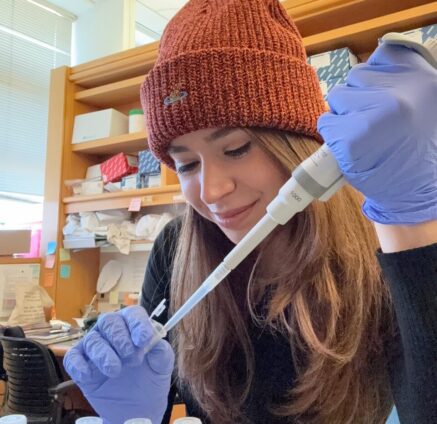
Researcher Spotlight: Understanding and Overriding Treatment Resistance in Chronic Myeloid Leukemia
February 2, 2026Ariel Leyte-Vidal, a PhD student at the University of Miami Miller School of Medicine, seeks to understand treatment resistance in the blood cancer chronic myeloid leukemia.
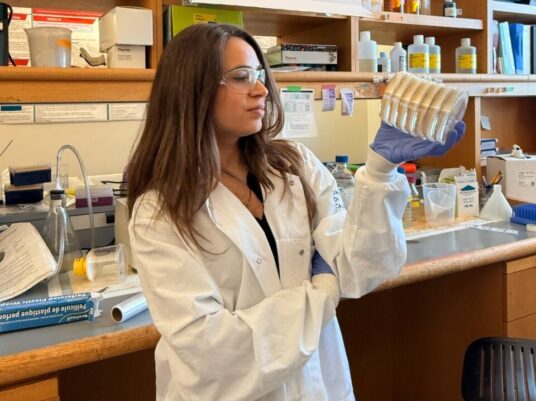
Ariel Leyte-Vidal is not one to often reminisce about the past, preferring to look forward to what’s next. But as she approaches the finish line for her PhD in biochemistry and molecular biology, she is thankful for the journey she’s taken.
“I have pushed myself to get here,” she said. “I’ve learned that I can go so much farther than what I thought, which has taught me resilience. I’ve gained so much knowledge that will be invaluable for the rest of my life, and it has only deepened my commitment to lifelong learning.”
Leyte-Vidal, a student at the University of Miami Miller School of Medicine, received a 2025 PhRMA Foundation Predoctoral Fellowship in Translational Medicine for her research focused on understanding treatment resistance in the blood cancer chronic myeloid leukemia (CML).
Her interest in cancer research began while working on an oncology floor in a hospital, where she encountered many patients undergoing cancer treatment. “I became very frustrated by the treatment options and the toxicities these patients had to endure, and I saw very unfavorable outcomes for many people,” Leyte-Vidal said. “From that point on, I knew that I wanted to help identify and override mechanisms of clinical resistance to targeted cancer therapies.”
CML arises from the fusion of two genes, BCR and ABL1, and the resulting BCR-ABL1 oncogene promotes uncontrolled growth of myeloid cells in the bone marrow, resulting in an overproduction of white blood cells. While treatments exist that can block the activity of BCR-ABL1, they don’t work in some patients, usually due to mutations that interfere with the drug’s ability to bind to the ABL1 kinase.
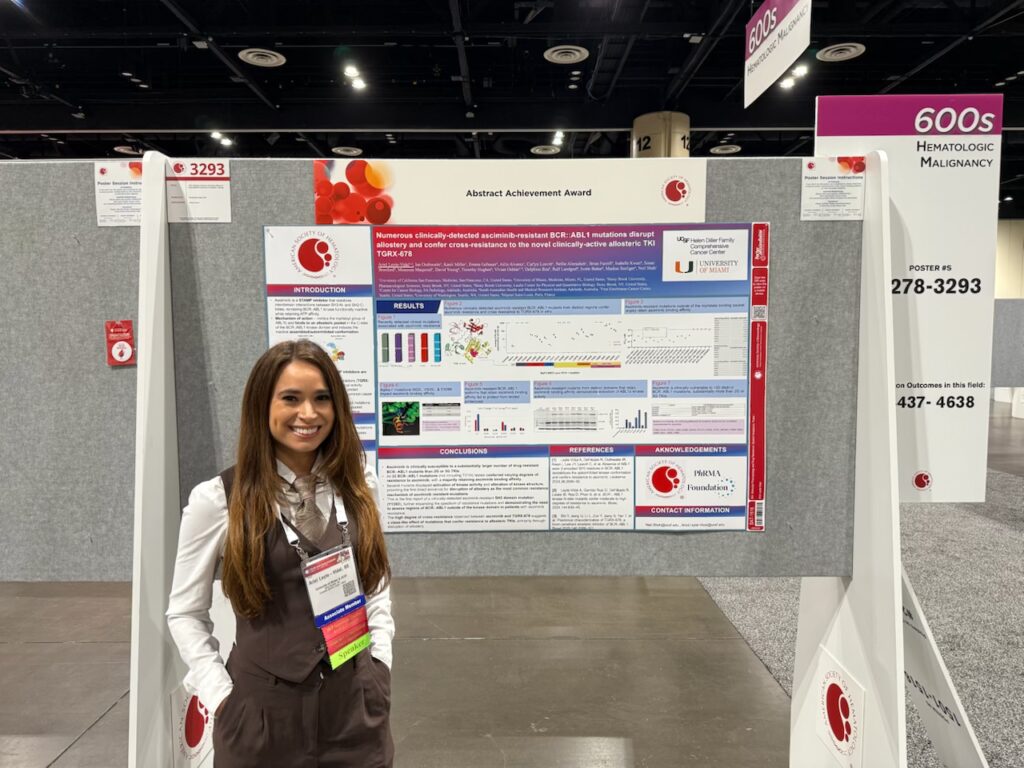
Leyte-Vidal is studying CML resistance to an FDA-approved treatment called asciminib, which is the first highly active allosteric kinase inhibitor. Her published research shows that patients have mutations that do not impact drug binding, yet they are still resistant to asciminib. She hypothesizes that these mutations are instead preventing the changes that asciminib normally causes to inactivate BCR-ABL1.
“My work now seeks to dive deeper into the mechanism and get more answers, so we make sure we give patients the best treatment options for them,” she said.
The PhRMA Foundation award arrived at a pivotal time, Leyte-Vidal said, emphasizing that current early career scientists are facing many outside pressures and funding challenges. “PhRMA Foundation’s investment in my work is a powerful affirmation signaling that my research is valued, and their belief in my capabilities fuels my determination to push the boundaries of scientific discovery,” she said.
One of Leyte-Vidal’s goals is to leverage her successes to mentor other underrepresented women to ensure “science is accessible and inclusive for all individuals, regardless of their background or socioeconomic status”.
“It is a well-known fact that women of minority representation in the scientific workforce have seen few gains in recent decades,” she said. “I have mentored underrepresented women in their undergraduate studies who have had no prior experience and showed them the techniques necessary to be fearless in their studies as well as develop the problem-solving skills they will need in science.”
When Leyte-Vidal gives advice to young researchers, she encourages them to trust their instincts, stay persistent, and not to be too hard on themselves. “It’s easy to get wrapped up in what people will tell you to do for advice in your career,” she said. “But you are the one in charge of your future and what you want to do with it.”
Looking forward, she wants to pursue a postdoctoral fellowship focused on structural biology and drug discovery, but her ultimate goal is to develop a drug that makes it all the way to patients. “What makes science truly extraordinary is its potential to deliver life-saving solutions on a grand scale.”