Researcher Spotlight: A Philosophy of ‘Good People, Good Science’
March 9, 2026Mark Milner, a postdoctoral fellow at the University of Michigan, is researching a potential novel therapeutic target for multiple sclerosis to protect against progressive neurodegeneration and dysfunction.
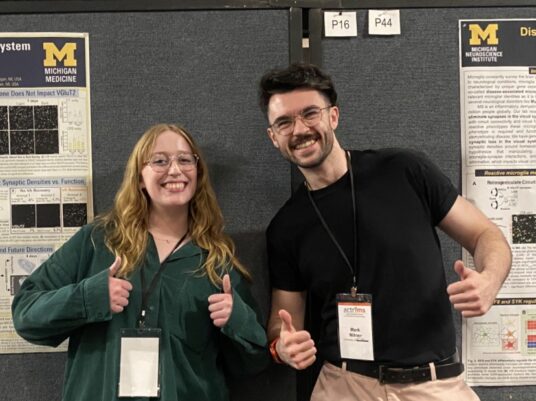
During his graduate studies, Mark Milner once heard a senior researcher claim that a lab needed to hire “good scientists, not good people.” For Milner, this statement was the antithesis of everything he believes about science.
“I want to surround myself with good people, and then good science will come from them when you work together and support each other,” he said. “It is so important to be in an environment that wants to see you not just survive but thrive. It’s so cliche, but it’s so true.”
Milner feels lucky to have had such positive experiences during his undergraduate studies in Ireland (where he grew up), his PhD studies in Australia, and now his postdoctoral training at the University of Michigan.
This research journey around the world began when he realized his passion for better understanding the causes behind human diseases. “I’m really interested in the mechanisms — how things go wrong in disease and how we can potentially fix them,” he said. “Definitely leaning into the translational-clinical side of things, as much as I do enjoy some basic science.”
This curiosity led him to explore a variety of conditions during his research experiences, including cystic fibrosis and rheumatoid arthritis, before he found his calling specializing in neurodegenerative diseases like Alzheimer’s disease and multiple sclerosis (MS).
Milner received a 2026 PhRMA Foundation Postdoctoral Fellowship in Translational Medicine for his research on potential treatments for MS, an autoimmune disease in which the body’s own immune cells attack the connections between nerve cells, interrupting signals to the brain and causing symptoms like vision loss, numbness and mobility issues. While current MS therapies reduce inflammatory attacks, many patients still experience progressive nerve degeneration, leading to permanent disability.
Specifically, Milner is investigating disease progression in the visual system, noting that visual dysfunction is often one of the first symptoms that patients notice. “If you wake up one day and your arm’s a bit weak, you might not necessarily think you need to go to the doctor,” he said. “But if you wake up and suddenly you’re not seeing very well through one of your eyes, you immediately realize something’s happened.”
His research focuses on the role of microglia, immune cells in the brain that he describes as being in a constant state of “surveillance” to maintain a healthy brain. However, in MS, microglia become overly reactive and cause excessive inflammation that destroys the connections between nerve cells, causing vision problems.
“My project is looking at those microglia and seeing whether we can essentially change them from being these angry inflammatory cells back to the happy cells that are just taking care of the brain,” Milner explained. He will test his hypothesis in both animal models and “microglia-like cells” derived from human patient blood. His goal is to demonstrate these cells could be a therapeutic target for protecting against progressive neurodegeneration and dysfunction in MS.
When Milner isn’t in the lab — and sometimes even when he is — he is likely thinking about netball, a sport he describes as a mix of basketball and ultimate frisbee. He was first introduced to netball in Australia, where he joined a team to make friends as he acclimated to a new country. His initial frustrating reaction to netball: “This is the stupidest sport I’ve ever played in my life.”

But his stubbornness to master the sport turned it into an obsession. “By the time I left Australia about 5 years later, I was playing six days a week in different leagues,” he said.
Unfortunately, there are no netball teams in Michigan, so Milner regularly makes the four-hour drive to Chicago just to play for an hour on Saturday mornings. He also travels to netball events in places like Los Angeles, Texas, North Carolina, and Vancouver, and recently played for the Netball America Stars team at the Dubai 7s tournament.
After he completes his postdoctoral training, Milner would like to move back to Ireland or the UK to start his own lab focused on investigating inflammatory pathways in neurodegenerative diseases. He envisions his lab would be a collaborative, supportive place that motivates trainees so they can grow as a person as well as professionally.
Learn more about the PhRMA Foundation’s fellowship and grant opportunities. Check out more researcher stories on our blog.