Researcher Spotlight: Investigating the Immune System’s Role in Blood Clotting Disease
November 16, 2026Thalia Newman, a PhD student at the University of Michigan, aims to develop new treatments for antiphospholipid syndrome (APS), an autoimmune disease that causes blood clots.
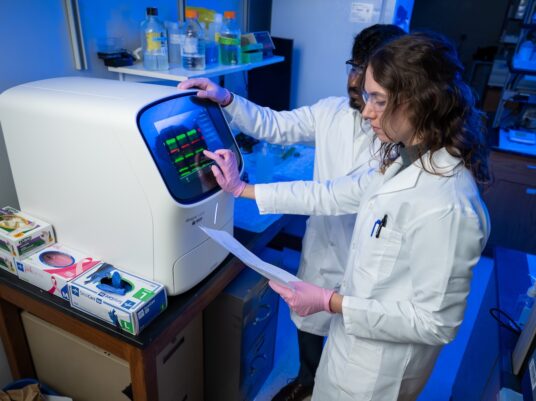
After sustaining a concussion in high school, Thalia Newman struggled with reading for months, forcing her to scale back her coursework. Yet, she constantly found herself wanting to spend her now-limited reading time on biology class.
“Throughout the year, whenever I had to pick one subject to focus on, I was always drawn back to biology,” she said.
This led Newman to pursue her bachelor’s degree in biology at Lafayette College, where she took her first immunology class and joined an immunology lab. Around that same time, her mother was diagnosed with rheumatoid arthritis, a chronic autoimmune disease that causes painful inflammation, swelling, and stiffness in the joints.
“I already had this underlying interest in immunology — it was calling to me — but that made it a lot more personal,” she said.
Now a PhD student at the University of Michigan, Newman received a 2026 PhRMA Foundation Predoctoral Fellowship in Translational Medicine for her research to better understand and develop new treatments for antiphospholipid syndrome (APS), an autoimmune disease that causes blood clots.
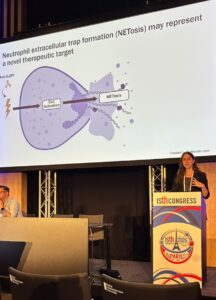 Currently, the only treatment available for people with APS is lifelong blood thinners, which doesn’t work for some patients. Many APS symptoms that aren’t addressed by blood thinners are driven by neutrophils, a type of white blood cells that become overactive in people with the disease.
Neutrophils fight infection by releasing sticky webs of DNA known as NETs, which capture and destroy invading germs. While this process, called NETosis, is an essential part of a healthy immune response, overactivation of the neutrophils can fuel harmful inflammation and cause dangerous blood clots.
Newman’s research aims to identify the key molecular signals that trigger NETosis in order to better control this process. “We’re hoping that my research can help identify new treatments for APS and uncover more insights about how these cells function in other inflammatory diseases as well,” she said.
The PhRMA Foundation’s support has boosted Newman’s confidence at a challenging time. “Science funding in the U.S. is kind of in a scary place right now, and being a young scientist is more daunting in a way that it hasn’t necessarily been before,” she said. “Providing support motivates me and shows that this work still matters.”
One of Newman’s favorite parts of research is the opportunity to discover something entirely new. “It is really rewarding — and also terrifying — just the idea that this is a completely undiscovered thing and suddenly you are the leading expert on it,” she said.
Newman has always enjoyed teaching and is currently mentoring two undergraduate students in her lab. “It’s helped me to understand my project better because they come in with questions and I’m explaining my own work more than I’ve had to before,” she said.
She encourages questions from younger researchers and advises them not to be afraid to ask. “A lot of my life, I was nervous to admit when I didn’t know something,” Newman said. “It’s OK to admit that you are unsure because if you never pose a question, then people might never consider it.”
Newman works with human blood every day and often the healthy donor samples come from her lab colleagues. “It’s really neat to be like, ‘Wow, these are this person’s cells that I’m looking at under this microscope right now and seeing how they function,’” she said.
Making the connection from person to cell is especially meaningful because Newman’s lab mates have become an important part of her community and support system at the University of Michigan. She did not know a single person on campus when she first arrived.
 “I had never been to Michigan. I had barely been to the Midwest. I just packed everything up and moved across the country to come here,” said Newman, who is originally from Seattle. “It’s been really rewarding and now I have a whole community here, both in science and out of it.”
Outside the lab, Newman participates in a graduate student acapella group. “I’ve been singing my whole life,” she said, adding that she previously participated in classical voice competitions in college.
For her future career, Newman wants to stay in academic research. After completing her PhD, she hopes to secure a postdoctoral position and then eventually lead her own lab focused on the innate immune mechanisms that drive autoimmune diseases.