Q&A with Dr. Taotao Wu: Measuring Brain Activity to Improve Concussion Diagnosis
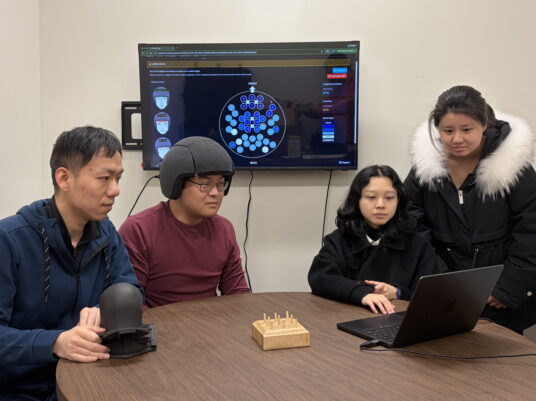
September 21, 2026Dr. Taotao Wu (second from left), an assistant professor at the University of Georgia, received a 2026 PhRMA Foundation Faculty Starter Grant in Translational Medicine.
Provide a summary of your PhRMA Foundation-funded research.
Brain injuries, such as concussions, affect millions of people every year and can have serious, lasting consequences. Yet diagnosing concussion remains challenging because standard brain scans often appear normal, so physicians still have to rely largely on symptoms and clinical assessments.
Our project aims to develop a more objective way to measure how the brain is functioning after a concussion. We use a portable brain-imaging system to measure brain activity while people complete thinking, memory, balance, and movement tasks — the same types of tasks physicians use to evaluate patients with concussion. We then use advanced computational methods to identify patterns of brain activity that distinguish people with concussion from healthy individuals and determine how those patterns relate to their symptoms.
Ultimately, we hope this work will lay the foundation for objective brain-activity markers that could help clinicians diagnose concussion more accurately, monitor recovery more objectively, and eventually provide more personalized care for people with brain injuries.
Why did you become a researcher?
I have always liked solving puzzles. Growing up, I loved detective stories and archaeology, anything where you have incomplete pieces of information and have to figure out what happened.
I went to college for engineering, and eventually I realized that research gives me the opportunity to essentially solve puzzles for a living. You have a problem where nobody knows the answer, you collect clues from experiments, data, and previous studies, and you try to put everything together into an explanation. The human brain is probably one of the most complicated puzzles we have, so there is always another question to solve.
Tell us an interesting story from your career journey.
That my research focuses on the brain is actually a little ironic because when I was a graduate student, the brain was probably my least favorite part of the body to study. My graduate lab studied biomechanics, and I worked on projects involving many different parts of the body. Brain tissue was extremely soft and difficult to characterize, and at the time, experimental results in the literature seemed to be all over the place and sometimes even contradicted one another. So I really didn’t want to work on the brain.
Then, in my third year, I needed to choose a dissertation topic. My advisor happened to have only one funded project available — a brain project. I like to say that I didn’t choose the brain; the brain chose me.
About three months into the project, I discovered an error in a model that had been widely used in the field and hadn’t really been questioned before. That was probably my first experience of realizing that, as a researcher, you don’t always have to accept what is already in the literature. Sometimes something that everyone assumes is correct is worth looking at again. That discovery completely changed how I felt about brain research, and I have never looked back.
What is a common misconception people have about science?
One misconception is that science is driven by “Eureka!” moments, that a scientist suddenly has a brilliant idea and everything falls into place. Those moments are actually pretty rare. Most scientific progress comes from slow, painstaking work: reading, testing ideas, getting things wrong, going back, and trying again. And there is another humbling experience every researcher knows. Sometimes you thought you had come up with a brilliant new idea, and then, once you really dig into the literature, you discover that somebody already published it in the 1980s. Science teaches you humility very quickly.
What do you love most about research?
I am naturally an introvert, so one thing I genuinely enjoy about research is being able to spend a considerable amount of time thinking deeply about one problem. That restores my mental energy. I like having the freedom to follow an idea, work through it at my own pace, and eventually understand something that I didn’t understand before. There is a lot of satisfaction in that.
And, if I can be a little less philosophical, I get to spend a lot of my time doing things I genuinely enjoy, and somehow, I get paid to do it. That’s a pretty good job.
What do you like to do outside of research?
I am a big basketball fan, both watching and playing when I have the chance. I also still love detective stories (movies, TV shows, and novels). I guess even outside the lab, I still like trying to figure out who did it before the answer is revealed.
What advice would you give to your younger self?
Celebrate your successes more. Academia involves a lot of failure. Papers get rejected, grants don’t get funded, experiments don’t work, and sometimes you can spend months on something that goes nowhere. We become very good at immediately moving on to the next problem.
I would tell my younger self that when something does work, take a moment and enjoy it. If you only remember the failures and immediately move past the successes, it becomes very difficult to appreciate how far you’ve come.
What are your career goals?
My goal is pretty simple: I want the work we do to eventually have a positive impact on people’s lives. That could mean developing a technology or scientific insight that improves how we understand, diagnose, or treat brain injury. But impact doesn’t have to come only from my own research. I also have the opportunity to train the next generation of scientists and engineers. If the students who come through my lab go on to make discoveries that I could never make myself, I would consider that a very successful career.
Learn more about the PhRMA Foundation’s fellowship and grant opportunities. Check out more researcher stories on our blog.