Researcher Spotlight: Looking Beyond GLP-1 Therapies to Treat Obesity
July 14, 2026Kate Bowman, a PhD student at the University of Michigan, received a 2026 PhRMA Foundation Predoctoral Fellowship in Drug Discovery for her research investigating alternative therapeutic targets for treating obesity.
Kate Bowman is a planner — but it was not her plan to change universities in the middle of her PhD studies. When her adviser took a new job, Bowman had to quickly make the life-changing decision of whether she would stay or move to a new school.
As it turned out, following her mentor to the University of Michigan provided new opportunities for her research and taught her a valuable life lesson. “I always needed to have a plan for any type of event that was happening in my life. I used to worry about everything,” she said. “But you really have to just go with the flow and embrace change.”
At Michigan, Bowman gained access to resources like the Center for Chemical Genomics and the Metabolomics Core that are helping advance her research into new therapeutics for obesity.
Current GLP-1 obesity treatments often have negative side effects such as gastrointestinal upset and muscle loss. Bowman received a 2026 PhRMA Foundation Predoctoral Fellowship in Drug Discovery for her research investigating alternative pathways in the brain that could be targeted to promote safe and sustained weight loss with fewer side effects.
She is studying a naturally occurring peptide called prokineticin 2 (PK2), which regulates appetite through signaling in the brain. Her lab has found that activating a specific PK2 receptor in the amygdala of mice causes them to eat less food.
Bowman is working to identify drug-like molecules that can activate this receptor to mimic the appetite-suppressing effects of PK2. She hopes her research could lead to innovative treatments that help people manage their weight by reducing hunger.
“This is a very novel mechanism, so it won’t have any overlap with GLP-1 agonists,” she said.
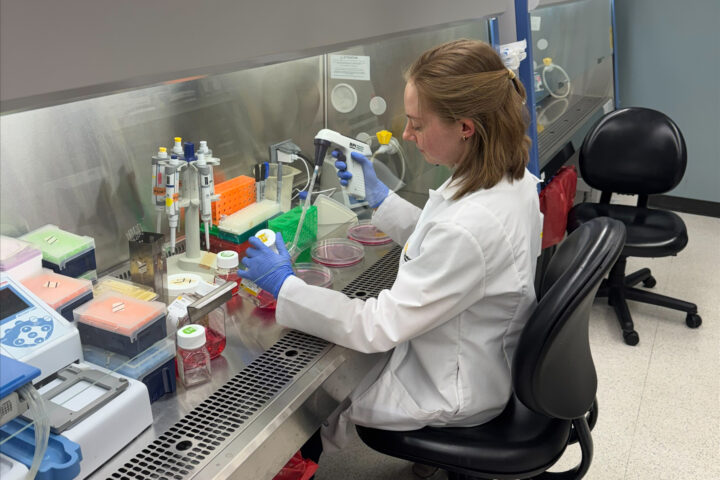 The PhRMA Foundation fellowship has given Bowman more time and resources to pursue her research project. “It gives me peace of mind in my research knowing that I don’t have to be stressed about the funding,” she said. “It makes me proud to know that I can support my lab and my PI by being self-sufficient in a sense.”
Bowman loves the freedom that research gives her to investigate any question she has and find the answer. “It may not be easy to get to that answer or very straightforward. In fact, it could take years to get to that answer, but there is an answer at the end,” she said. “I find that to be very rewarding.”
As she looks toward the next stage of her career, Bowman wants to pursue a postdoctoral fellowship where she can hone her leadership skills. “I haven’t had many opportunities to provide mentorship here in this lab because I’m the youngest one,” she said. “It’ll be a good test for that.”
Plus, it will give her more time to decide whether she wants to stay in academia or move into industry. But Bowman is approaching this decision differently than she once would have.
“Things are going to happen as they will, and oftentimes things will turn out better than you ever could have hoped or planned for,” she said. “Just go where the data takes you, go where life takes you, and it’s all going to work out.”