Researcher Spotlight: Studying Muscle Loss in Cancer to Improve Patient Outcomes
April 23, 2026Alice Wang, a fifth-year MD‑PhD student at Stony Brook University, is developing a potential treatment for cancer cachexia, a wasting condition where cancer patients lose significant amounts of skeletal muscle and fat.
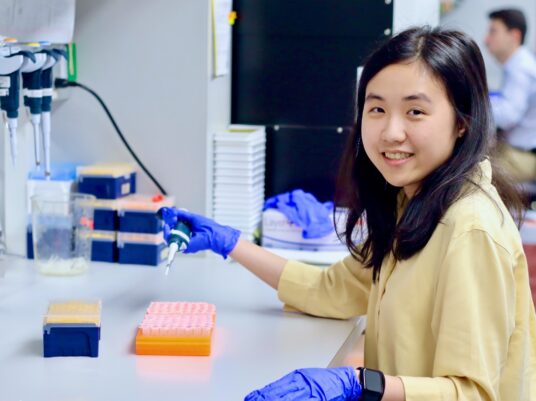
Witnessing how a new medicine dramatically transformed patients’ lives was the moment that solidified Alice Wang’s path toward becoming a physician‑scientist.
While working in a translational research lab at Yale University, Wang saw patients with severe inflammatory skin disease respond remarkably well to a new therapy developed through years of research. “That really prompted my interest in a career where I could do basic science research but also see patients and translate my research findings into the clinic to help patients,” she said.
Wang is now a fifth-year MD‑PhD student at Stony Brook University conducting her doctoral research at Cold Spring Harbor Laboratory. She received a 2026 PhRMA Foundation Predoctoral Fellowship in Drug Discovery for her research focused on developing a potential treatment for cancer cachexia, a wasting condition where cancer patients lose significant amounts of skeletal muscle and fat.
“Patients with cancer cachexia have worse treatment response to cancer therapies and often worse survival that patients who do not experience this type of systemic wasting,” Wang said.
Despite its profound impact on patients, there are currently no FDA-approved treatments for cancer cachexia. Wang’s research aims to help fill this gap by identifying novel strategies for rehabilitating and regaining skeletal muscle mass. She developed a mouse model that allows her to study skeletal muscle changes throughout cancer progression and identify potential therapies that can help restore muscle mass and function.
Wang noted that the realities of research are often misunderstood by non-scientists. “Even my friends or family members don’t realize how much time it takes,” she said. “It’s very different from having a 9-to-5 job.”
She looks forward to the moments when the data finally validates her hypothesis after weeks or even months of experiments. “Those are the really gratifying moments that I enjoy,” she said.
Wang learned early on in her career journey to keep pushing through uncertainty. She was born in the U.S. but grew up in Taiwan before returning to the U.S. for college. “That transition for me was not easy,” she said. “Even though I learned an English as a kid, it’s not my first language. My parents weren’t really award of how college admissions worked in the U.S. or how to medical school application works.”
Navigating those processes made her more independent and mature at a younger age, she explained, and shaped the advice she now shares with other early career researchers: “Do not be afraid and do what you enjoy.”
Outside the lab, Wang values taking time to recharge. She enjoys taking long runs to decompress and to stay both physically and mentally healthy. She is especially proud of herself for completing the New York City Marathon last year.
Looking ahead, Wang plans to complete medical school and pursue a research-focused residency. While she hasn’t decided on a specific medical specialty yet, her long-term goal is to become a physician-scientist who balances seeing patients and conducting translational research that leads to better, more effective therapies.