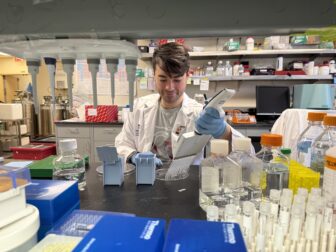
Meredith Nix

Converting Oncogenic Condensates into Therapeutic Cell Death Switches
Abstract
EML4-ALK fusion proteins, which arise from a chromosomal translocation between Echinoderm Microtubule-Associated Protein-like 4 (EML4) and Anaplastic Lymphoma Kinase (ALK), drive 4% of all non-small cell lung cancers (NSCLC). While ALK inhibitors provide initial clinical benefit, resistance ultimately develops, limiting long-term efficacy and underscoring the need for alternative therapeutic strategies. Notably, EML4-ALK fusion proteins undergo liquid-liquid phase separation to form biomolecular condensates. This proposal seeks to exploit the condensate nature of EML4-ALK to cluster and turn on dimerization-activatable death effector proteins, such as caspases, through a new class of bivalent small molecules called Molecular Kill Switches. Successful completion of this proposal will introduce a fundamentally new drug discovery strategy that co-opts, instead of disrupts, disease-associated condensate activity to selectively kill cancer cells.
I am honored to receive the PhRMA Foundation Predoctoral Fellowship and join a community of scholars committed to advancing biomedical discovery. This award will enable me to develop molecular glues targeting cancers driven by fusion proteins.