Beyond the Bench: Exploring Learning Opportunities Outside of Lab
January 21, 2026Learning experiences outside of the classroom or lab can provide early career scientists with valuable insights into potential career paths and expose them to new research ideas.
The idea of pursuing learning opportunities outside of the classroom or lab might feel daunting to some early career researchers. But these experiences can provide students with valuable insights into potential career paths and expose them to new research ideas. Many PhRMA Foundation (PhF) awardees engage in such activities, and we interviewed two of them about their experiences and advice for other trainees.
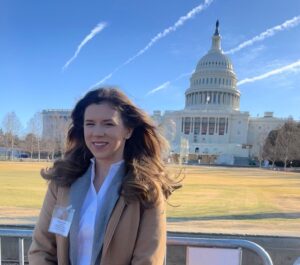
Carol Morris at the U.S Capitol
Carol Morris, a postdoctoral fellow at the University of Arkansas for Medical Sciences (UAMS) and 2024 PhF awardee in Drug Discovery, was selected for a science communication fellowship with the Association for Research in Vision and Ophthalmology (ARVO). “In science, it’s really important to be able to communicate your findings and to get other people excited about your research,” she said. “Whether it’s writing a grant application or giving a seminar, you need to be able to communicate science effectively.”
Morris participated in trainings, conducted outreach activities, and traveled to Washington, D.C., in February 2025 to lobby Congress on the importance of research funding. “The general public needs to understand why science funding is so important, why what we’re doing is so important for the health of the community and for the public,” she said.
When Morris met with Congressional staffers, she focused on connecting with them on a personal level and giving clear examples of the impact of science. “You don’t have a long time to build relationships with staffers” she said. “You should make sure that your message is well tailored to them so that they can get emotionally invested in a short time. … That was the most challenging part. But I like a challenge, and it was fun to do.”
Morris has taken on many challenges outside the lab during her studies. She won first place out of 70 contestants in the UAMS Three Minute Thesis (3MT) competition, where she presented her research in simple, compelling language.
She also participated in a Healthcare Innovation Sprint, a training program that guides students through the process of launching a health care venture. They identify potential health care challenges, engage with key stakeholders, and develop solutions. “At the end of the week, we did a pitch in front of people who work in health care, people who are investors, scientists and non-scientists, so a mixture of backgrounds was represented.” Her team earned first place.
These efforts outside of the lab helped Morris secure a spot in the UAMS 2025 Health Sciences Innovation and Entrepreneurship Postdoctoral Training Program, which focuses on training researchers in business principles, entrepreneurial skills, team science, and strategies to innovate and commercialize health care technologies.
Taking on different opportunities outside of the lab helps build a researcher’s CV and gives them new perspectives on health care problems that need to be solved, Morris said. “I think it’s really important to get as many different perspectives on science as you can while you’re in your training,” she added.
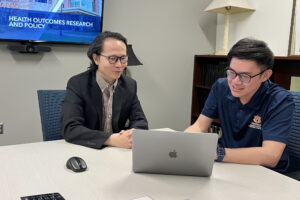
Tim Lai (right) with his advisor Surachat Ngorsuraches, PhD
Tim Lai, a PhD student at Auburn University and 2025 PhRMA Foundation Predoctoral Fellow in Value Assessment and Health Outcomes Research, worked as a summer intern at AbbVie in 2025 and as a Health Equity Research Fellow at the Center for Innovation & Value Research (CIVR) in 2023. CIVR is a health policy nonprofit based in Washington, D.C., previously known as the Innovation and Value Initiative. “With these fellowships, it’s a great opportunity and actually a great deal — people pay me to learn,” Lai said.
He said his adviser pushed him to apply for opportunities outside the lab to explore career paths. “He knows that the job market is tougher than 20 years ago,” Lai said. “He knows that we, as a new generation of HEOR researchers, need to demonstrate our capability and explore more options proactively.”
The summer pharmaceutical internship was very fast-paced and project-oriented, he said. Lai met with a mentor once a week who helped guide him through figuring out his project and goals and monitored his progress. “I knew I was expected to achieve something within three months,” he said.
The internship also provided him with invaluable experience working in a pharmaceutical company. “People at the company were very willing to share their experience and provide career advice, and that was very helpful to me,” he said.
On the other hand, Lai’s yearlong, remote fellowship at CIVR was more flexible and self-directed. CIVR hosts many patient engagement activities, which allow fellows to engage with patients in ways they might not be able to at school. “They want to help us understand what patient-centered outcomes research really looks like,” he said.
These patient engagement opportunities also helped Lai better discern the nuances between different kinds of patient-centered research. “Patients, when they are involved early in your study, can directly change your research track to focus on what matters to them,” he said.
He recommended that students talk with their advisors as early as possible about potential opportunities outside of the lab. “They’ve observed you for a long time, they know your capabilities, and they will help prioritize things for you if you don’t know what to do,” Lai said.
Morris encouraged early career researchers to always be on the lookout for opportunities. “There are a lot of experiences that people don’t even sign up for. There are a lot of things that are not as competitive as you would think, so put in your application no matter what it is,” she said. “I am constantly applying to things, and I don’t get a lot of them, but then I do get some of them. Just put yourself out there and see where you land because you might end up in a whole different route that you would have never taken had you not had that experience.”